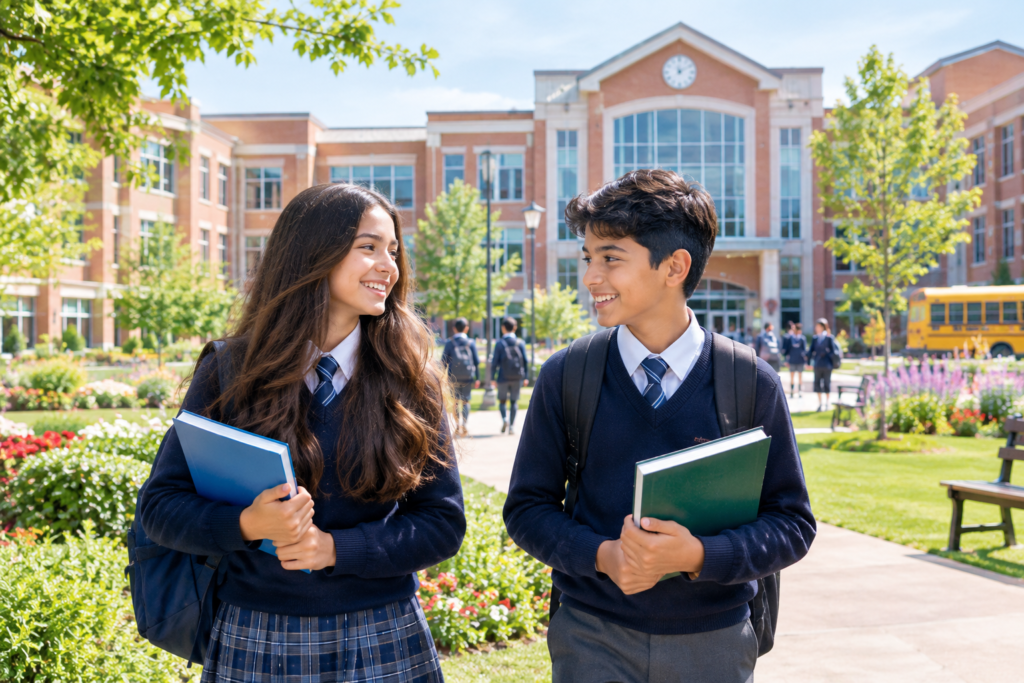
Base education refers to the foundational learning that helps students develop the knowledge, skills, habits, and attitudes needed for later education and everyday life. It generally includes the early stages of learning where children build essential abilities in reading, writing, mathematics, communication, social interaction, and problem-solving. A strong educational foundation can make it easier for students to understand more advanced subjects as they progress through school. Base education is not limited to academic knowledge. It also involves curiosity, confidence, discipline, creativity, cooperation, and the ability to learn independently. When these foundations are developed effectively, students are better prepared to handle new concepts, adapt to different learning environments, and continue developing throughout their academic journey.
What Does Base Education Mean?
Base education can be understood as the starting point of a learner’s academic development. It covers the fundamental concepts that students need before moving into more specialized or advanced areas of study.
During these early stages, students commonly learn basic literacy and numeracy. They may learn how letters and sounds work, how to form sentences, how to read simple texts, and how numbers can be used for counting and calculations. At the same time, children begin learning about their surroundings through subjects such as science, social studies, art, and physical education.
The exact meaning of base education can vary depending on the education system. In some contexts, it may refer mainly to primary education. In others, the term can describe a broader foundation that includes early childhood learning and the development of basic academic and social skills.
Why Foundational Learning Matters
Early learning has a major influence on how students approach future education. A child who develops basic reading skills can gradually move from learning to read toward reading to learn. Similarly, understanding fundamental mathematical ideas creates a foundation for algebra, geometry, statistics, and other advanced subjects.
Foundational education also helps students develop learning habits. Paying attention, completing assignments, asking questions, working with classmates, and organizing schoolwork are skills that can remain useful for many years.
A strong foundation does not mean every student must progress at exactly the same speed. Children have different interests, abilities, experiences, and learning needs. Effective education provides opportunities for students to develop these foundations while receiving appropriate support when they encounter difficulties.
Key Areas of Base Education
Literacy and Language
Language development is one of the most important components of foundational education. Students learn vocabulary, pronunciation, reading comprehension, writing, grammar, and communication.
Reading allows children to access information independently. Writing helps them communicate ideas, organize thoughts, and demonstrate what they have learned. Speaking and listening skills are equally important because students need to participate in discussions, follow instructions, and communicate with teachers and classmates.
Strong language skills can support learning across almost every subject because students often need to read instructions, understand questions, explain ideas, and interpret information.
Mathematics
Basic mathematics gives students tools for understanding quantities, patterns, measurements, and relationships.
Early mathematical learning may include counting, addition, subtraction, multiplication, division, shapes, fractions, measurement, and simple problem-solving. As students progress, these concepts become foundations for more complex mathematical topics.
Practical activities can make mathematics easier to understand. Measuring objects, comparing quantities, working with money, reading calendars, and solving everyday problems can help connect classroom concepts with real situations.
Science
Science education encourages students to observe the world and ask questions about how things work. Foundational science may introduce children to plants, animals, weather, matter, energy, the human body, Earth, and the environment.
The goal is not simply to memorize facts. Students can also learn basic scientific thinking by making observations, asking questions, forming explanations, conducting simple investigations, and discussing evidence.
These habits can support later study in biology, chemistry, physics, environmental science, and other scientific fields.
Social Studies
Social studies helps students understand people, communities, history, geography, government, and culture.
At the foundational level, students may begin by learning about their families, schools, neighborhoods, and communities. They can gradually develop a broader understanding of different places, historical events, and social systems.
This area of education can also encourage students to understand responsibilities, cooperation, rules, community participation, and respect for differences.
Social and Emotional Development
Academic learning is only one part of a child’s development. Students also need opportunities to develop communication, cooperation, self-control, empathy, and confidence.
Classroom activities can help children practice sharing ideas, working in groups, resolving disagreements, managing frustration, and responding appropriately to different situations.
These abilities can influence classroom participation and relationships with teachers and classmates. They can also remain useful beyond school.
The Role of Teachers in Base Education
Teachers play an important role in helping students establish strong educational foundations. They introduce concepts, identify areas where students need additional support, provide feedback, and create activities that encourage participation.
Effective teaching can involve different approaches because students do not all learn in the same way. Some students may benefit from visual materials, while others may understand a concept more easily through discussion, practical activities, demonstrations, or repeated practice.
Teachers can also monitor progress and adjust instruction. Regular assessment does not always need to involve formal examinations. Classroom conversations, assignments, reading activities, projects, and observations can provide useful information about student understanding.
The Importance of Parents and Families
Learning does not stop when the school day ends. Parents and caregivers can reinforce foundational skills through everyday activities.
Reading together, discussing new vocabulary, practicing simple calculations while shopping, exploring nature, playing educational games, and talking about school experiences can create additional learning opportunities.
Family support can also involve establishing consistent routines. Having a suitable time for reading, homework, sleep, and recreation can help children develop habits that support learning.
Parents do not need to turn the home into a classroom. Simple conversations and activities can provide meaningful opportunities for children to practice what they learn at school.
Technology in Foundational Education
Digital technology has become increasingly common in education. Computers, tablets, educational platforms, interactive activities, digital books, and learning applications can supplement classroom instruction.
Technology can provide students with additional opportunities to practice skills at their own pace. Interactive exercises may offer immediate feedback, while educational videos can introduce concepts through visual demonstrations.
However, technology works best when it supports clear learning goals. Students also need opportunities for reading physical books, writing, discussion, hands-on activities, movement, and face-to-face interaction.
Teachers and families can therefore consider both the educational value of a digital activity and the amount of time a child spends using a device.
Base Education and Different Learning Needs
Students enter classrooms with different experiences and learning needs. Some may quickly understand foundational concepts, while others may need additional practice or alternative explanations.
Supporting different learners can involve small-group instruction, additional practice, visual materials, assistive technology, differentiated assignments, or individualized educational support.
Early identification of learning difficulties can be helpful because students can receive appropriate assistance before gaps become more difficult to address.
Inclusive education also means creating learning environments where students can participate meaningfully regardless of their individual circumstances.
Learning Through Play and Practical Activities
Play can be an important part of early learning. Games, building activities, storytelling, drawing, puzzles, role-playing, and movement can provide opportunities to develop language, reasoning, coordination, creativity, and social skills.
Practical learning can also make abstract ideas easier to understand. For example, students can learn measurement by working with real objects, explore science through simple experiments, or develop writing skills by creating stories about familiar experiences.
These activities can make learning more active and give students opportunities to apply concepts rather than only memorize information.
Developing Critical Thinking
Base education should help students become curious learners. Instead of always receiving answers immediately, students can be encouraged to explain their reasoning, compare possibilities, ask questions, and find evidence.
Simple questions such as “Why do you think that happened?” or “How could we solve this another way?” can encourage deeper thinking.
Critical thinking developed during early education can become increasingly valuable as students encounter more complex academic subjects and information sources.
Building a Positive Attitude Toward Learning
Students’ attitudes toward education can influence how they respond to challenges. If children understand that mistakes can be part of learning, they may become more willing to attempt difficult tasks.
Teachers and families can encourage persistence by focusing on effort, progress, strategies, and improvement rather than treating every mistake as failure.
A positive learning environment can also give students opportunities to express curiosity and explore subjects that interest them. This can help transform education from a task that must simply be completed into an ongoing process of discovery.
Preparing Students for Future Education
The purpose of foundational education is not to teach every concept a student will eventually need. Instead, it provides the starting point from which more advanced learning can develop.
Students who build strong literacy skills can approach increasingly complex texts. Those who understand mathematical foundations can move toward advanced mathematics. Students who develop research and reasoning skills can investigate more complicated scientific and social questions.
The academic foundation is therefore connected to later education at every level, from secondary school to vocational programs, college, university, and lifelong learning.
Conclusion
Base education provides the foundation upon which much of a student’s future learning can be built. It includes literacy, mathematics, science, social studies, communication, social development, problem-solving, and learning habits. Strong foundations are developed through cooperation among teachers, families, schools, and students. Classroom instruction can be strengthened through practical activities, appropriate technology, reading, discussion, play, and individualized support. Because students develop at different rates, foundational education should provide both consistent expectations and suitable learning opportunities. When children are given the knowledge and skills needed to approach new ideas with curiosity and confidence, they have a stronger starting point for continued academic and personal development.
Frequently Asked Questions
What is base education?
Base education refers to foundational learning that develops essential academic, social, communication, and problem-solving skills needed for later education.
What subjects are included in base education?
Common areas include language and literacy, mathematics, science, social studies, physical education, arts, and social-emotional development.
Why is foundational education important?
It gives students essential knowledge and learning habits that can support more advanced subjects and future educational experiences.
How can parents support base education at home?
Parents can support learning by reading with children, practicing everyday mathematics, discussing school topics, encouraging questions, and maintaining consistent learning routines.
Does technology help foundational learning?
Technology can support learning when it is connected to clear educational goals. It is most effective when balanced with reading, discussion, practical activities, movement, and social interaction.
Is base education the same in every country?
No. Education systems use different structures, terminology, curricula, and age ranges. The specific meaning of foundational education can therefore vary by country and educational system.
How can teachers support students who struggle with basic concepts?
Teachers can use additional practice, different explanations, small-group instruction, visual resources, differentiated activities, and appropriate educational support based on the student’s needs.
What skills should students develop through foundational education?
Important skills include reading, writing, mathematics, communication, collaboration, problem-solving, critical thinking, self-management, creativity, and independent learning.
| Read Also : How Distance Learning Transforms Education for |